
NOESIS · Artificial Intelligence
Why Build a Tiny Transparent AI System?
Why small, inspectable AI systems help engineers understand the layers beneath modern AI abstractions.
In this article
Modern AI systems are extraordinarily capable, but most engineers encounter them through abstractions: hosted APIs, SDKs, chat interfaces, prompt templates, orchestration frameworks, vector stores, and agents. Those abstractions make AI useful. They also hide the path between language and computation.
That hidden path matters. A business question does not enter a model as a human sentence. It is normalized, split into tokens, mapped to numeric identifiers, converted into vectors, arranged as tensors, transformed by learned parameters or application logic, and finally expressed back as an answer. MAGPAI exists to make that path visible.
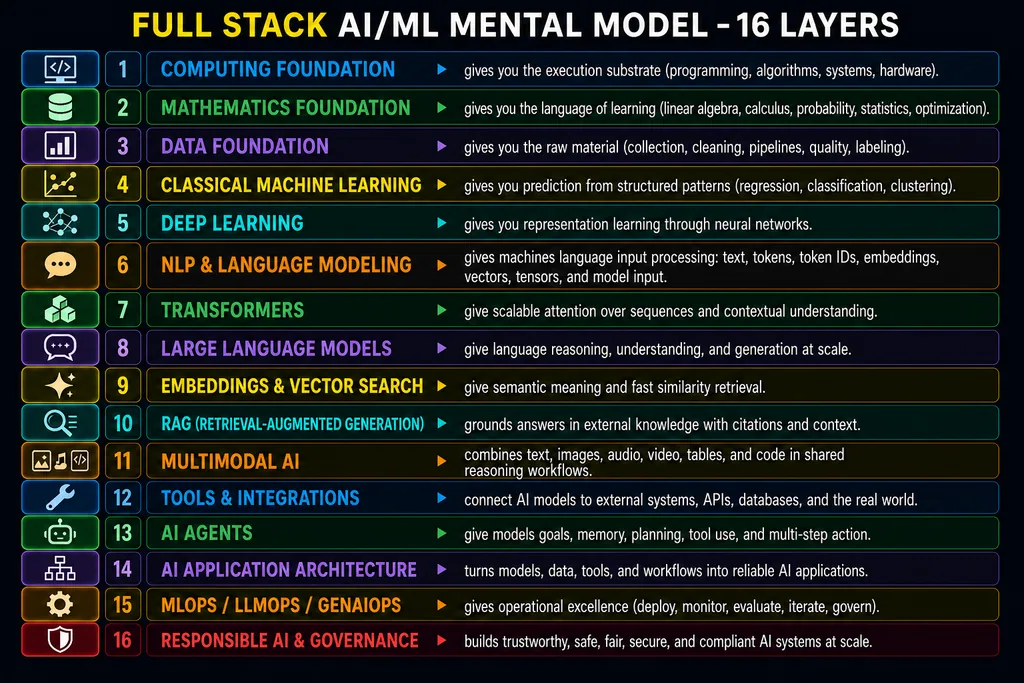
Where MAGPAI starts in the AI/ML stack
MAGPAI begins with a stack-level mental model. The point is not to claim that AI is one technique or one library. The point is to show that AI work sits on accumulated layers of computing, mathematics, data, machine learning, deep learning, language modeling, system design, operations, and governance.
The MAG Prototype AI starts its educational journey at the language layer 6: NLP and language modeling. That is the point where a human business question begins turning into model-ready numeric input. The repeated vocabulary for the session is deliberately concrete: text, tokens, token IDs, embeddings, vectors, tensors, and model input.
The stack also matters because each layer has a different technical foundation:
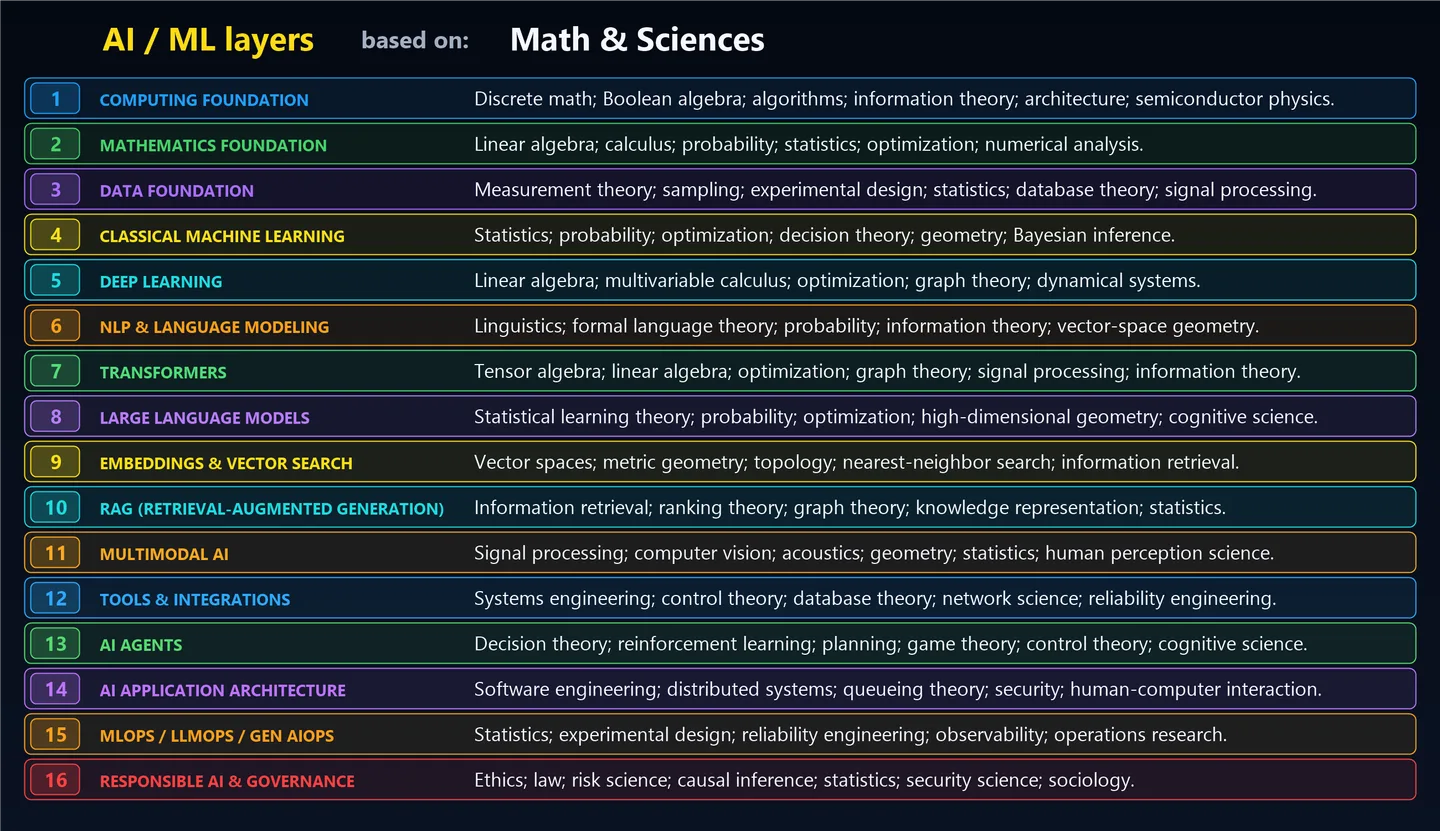
That is why MAGPAI starts small. It does not try to explain every layer at once. It chooses one entry point, language becoming numeric input, and makes that path inspectable before moving outward to larger system concerns.
The abstraction gap
There is a real difference between calling an AI service, integrating an AI model, understanding how a model represents input, and operating an AI-enabled enterprise system responsibly.
Calling a service proves that an interface can be invoked. Integrating a model proves that a product workflow can use AI behavior. Understanding the representation layer requires a different kind of evidence: tokens, token IDs, vectors, tensors, activations, parameters, and data access need to be visible enough that engineers can reason about them.
Abstraction is not the enemy. Software engineering depends on abstraction. Nobody wants every product team to implement tokenizers, tensor operations, model-serving infrastructure, and governance controls from first principles before they can build useful systems. The problem is not abstraction itself; the problem is relying on abstraction without a mental model of what sits underneath it.
Engineering leaders need both. They need productivity from APIs and platforms, and they need enough technical depth to evaluate architecture, operational risk, vendor claims, internal demos, security boundaries, and the difference between a learned behavior and deterministic application logic.
Why small systems are useful
A tiny educational system cannot reproduce the capability of a frontier model. That is not its purpose. Its advantage is that the moving parts are small enough to inspect.
Large models are useful because they compress enormous scale into a usable interface. Small systems are useful because they remove enough scale for the mechanism to become legible. In a teaching system, the embedding table can be printed. The token list can be shown. A tensor shape can be explained. A classifier decision can be traced. The data lookup can be separated from the model-facing representation.
That makes small systems valuable for learning:
- they have fewer hidden moving parts;
- they make intermediate representations inspectable;
- they can use deterministic demonstrations where determinism improves explanation;
- they let engineers trace state across each step;
- they are inexpensive to run locally;
- they support quick experimentation;
- they clarify boundaries between model behavior, application orchestration, and data access.
MAGPAI is deliberately small for those reasons. It is not a miniature commercial LLM. It is an educational model and demonstration laboratory built so the mechanics can be discussed with evidence on the screen.
Transparency as an engineering property
In engineering, transparency should mean more than a reassuring label. A transparent system lets an engineer identify the input, the transformation, the output, and the evidence at each step.
MAGPAI uses one stable business question to make those transformations inspectable. The point is not merely to show that an answer was produced. The point is to show what changed as the question moved through the system:
- Business questionThe human-facing request: "Are MAG sales up in Chicago?"
- TokensThe sentence is split into visible units such as words and punctuation.
- Token IDsEach token is mapped to a numeric vocabulary identifier.
- Vectors and embeddingsToken IDs become numeric vectors that can enter model-facing computation.
- Tensors and activationsVectors are arranged as tensor-shaped runtime state and transformed by model-like logic.
- Processing and data accessThe demo separates model-facing interpretation from application code and sample sales data.
- Business answerThe final response can be traced back to intermediate state and data-backed evidence.
That is the engineering value of transparency: every step creates something that can be named, inspected, logged, tested, or challenged. Was the transformation deterministic? Was it learned? Was it generated from sample data? Was it retrieved from a trusted source? Could the result be explained after the fact?
MAGPAI does not present an answer as an unexplained black box. It treats the intermediate artifacts as part of the learning surface.
The MAG business question
MAGPAI uses a fictitious company named MAG that sells products in Chicago. The recurring question is:
Are MAG sales up in Chicago?
That stable question is useful because it keeps the demonstrations grounded. Visitors can compare the human-facing business question with the model-facing representation at every layer. The same intent can flow through tokenization, vocabulary lookup, embeddings, tensor construction, data access, visualization, trace output, and bounded tool use.
MAG is fictitious. The data is educational or generated for demonstration. That boundary matters because the point is not to publish a business analytics system. The point is to show how a question becomes computable state and how an answer can be connected back to visible runtime behavior.
From educational prototype to engineering laboratory
MAGPAI is more than a single demo. The public repository combines explanatory documentation, diagrams, Python source, interactive applications, notebooks, tests, presentation material, local runtime demonstrations, and generated-report locations.
The current learning module starts with an AI/ML stack orientation, then walks through tokens, token IDs, vectors, embeddings, tensors, and a chart-backed answer. The GitHub repository includes a 19-slide PowerPoint, material in an Obsedian based teleprompter called Diavgeia, MkDocs documentation, tokenizer and embedding demos, a chart-backed answer demo, a chatbot with trace mode, and automated tests for the chatbot pipeline.
Executable examples matter because they turn explanation into evidence. A slide can name the concept. A diagram can orient the architecture. A local command or interactive demo can show the artifact that the concept produces.
Why this matters for AI-augmented engineering leadership
AI-augmented engineering does not remove the need for engineering judgment. It raises the cost of weak judgment because more behavior is mediated through systems that are probabilistic, data-dependent, vendor-operated, or difficult to inspect.
Teams need to understand which parts of an AI-enabled system are learned, deterministic, externally controlled, or driven by local application code. They need observability that captures more than HTTP status and latency. Business answers should be traceable to data, prompts, model behavior, runtime state, and policy decisions. Safety boundaries should be designed, tested, and operated rather than assumed.
That does not mean every leader must become a model researcher. It does mean that technical leaders need enough depth to ask precise questions:
- where does the model stop and the application begin?
- what data influenced this answer?
- what intermediate state can we observe?
- what behavior is deterministic, and what behavior is learned?
- what failure modes are hidden by the user interface?
- what safety boundary is enforced by code, configuration, policy, or human review?
MAGPAI is useful because it gives those questions a small, inspectable environment.
What MAGPAI is not
MAGPAI is not a production foundation model. It is not a claim to reproduce a commercial LLM. It is not a benchmark against frontier systems. It is not a substitute for enterprise security, governance, safety, model operations, or production architecture.
It is an educational model, an inspectable demonstration environment, an engineering laboratory, and a progressive explanation of AI concepts. Its value comes from making the internal path visible, not from pretending that a tiny teaching system has production-scale capability.

About the author
Vasili Katsoulis
Vasili Katsoulis believes the future belongs to engineering leaders who understand both timeless software engineering principles and modern AI. His work explores how technical depth, architectural thinking, and engineering judgment enable organizations to build better software in the age of AI.