
NOESIS · Engineering Leadership
What Does It Take to Bring AI Into Your Organization?
From a Starter AI Lab to a Multi-Million-Dollar Enterprise AI Platform.
In this article
- Start with the boundary, the owner, and the outcome
- Five models, with different reasons to exist
- Put the cost ranges in context
- Make the Starter phase an evidence-producing capability
- A private environment is a set of enforced boundaries
- Compliance follows the data and the business process
- Measure the workload before choosing the scale
- Example: Azure Deployment Options and Costs
- Example: What an Azure Starter AI Lab Should Measure
- Example: Where the Azure Starter AI Lab Budget Goes
- The 90-Day Decision Gate
- Enterprise scale is an operating model
- Three decisions the evidence should support
What does it take to bring AI into your organization?
The answer is rarely just a model, a GPU cluster, or access to a cloud service. It is a combination of useful problems, approved data, engineering capability, security controls, operating discipline, and evidence that the investment produces something worth sustaining.
The financial range is correspondingly wide. A controlled Cloud Starter AI Lab might have a first-year platform and experimentation envelope of $100K–$300K. A permanent enterprise platform can require millions or tens of millions of dollars. Those figures describe different scopes of capability, not different prices for the same thing.
The wrong first question is, “How large an AI platform should we build?”
The better question is:
What is the smallest secure AI capability that can give us enough evidence to determine what we should build next?
That question changes the sequence of investment. Start small enough to learn. Govern well enough to trust. Measure carefully enough to know when to scale.
Start with the boundary, the owner, and the outcome
Before choosing infrastructure, choose three to five measurable use cases, name their business owners, and establish a baseline. What does the current process cost? How long does it take? What errors matter? Who will decide whether the AI-assisted result is acceptable?
Good early candidates include document intelligence, retrieval-augmented generation (RAG), internal search and knowledge assistance, developer AI, forecasting, and natural-language-to-SQL over approved data. Controlled agents can also be useful when their tools, permissions, spending, and approval steps are deliberately limited. A conversational interface alone is not evidence of a better business process.
Regulated and proprietary data help determine the architecture from the beginning. Every dataset needs an owner, classification, approved purpose, permitted AI uses, retention policy, and access model before ingestion. A promising demonstration does not justify an exception to those decisions.
For highly regulated information, start from default deny until the required approvals and controls exist. Prefer synthetic, de-identified, masked, tokenized, or aggregated data during early experimentation, while recognizing that these techniques have different residual risks. Masking a field does not establish that an entire dataset is anonymous.
Five models, with different reasons to exist
There is a useful middle ground between an isolated demonstration and a permanent enterprise AI estate. Five models make the choices clearer. Their names describe deployment and investment patterns; they are not a maturity score, and an organization does not have to pass through all five.
Cloud Starter AI Lab
A Cloud Starter AI Lab prioritizes rapid setup, low initial capital, managed services, and elastic experimentation. An approved private environment can combine model APIs, rented compute, storage, a controlled retrieval layer, and basic evaluation and deployment tooling.
This is often a useful starting point when demand is uncertain and learning speed matters. Budget alerts, quotas, idle shutdown, endpoint access controls, and explicit data-processing terms belong in the initial design. Cloud elasticity can reduce idle hardware, but poorly bounded consumption can still become expensive.
On-Prem Starter AI Lab
An On-Prem Starter AI Lab uses a limited amount of owned compute and storage inside a controlled environment. It can be appropriate when physical data custody, existing facilities, predictable local demand, or research constraints justify the operational effort.
The investment includes more than accelerators: host memory, storage throughput, networking, power, cooling, support, and recovery arrangements all matter. A small installation has limited elasticity and may have a single point of failure. Keeping equipment nearby does not automatically secure the software or the data on it.
Cloud Enterprise AI Lab
A Cloud Enterprise AI Lab turns a useful capability into a shared service for multiple teams. It adds governed environments, reusable pipelines, model and data registries, evaluation gates, observability, cost allocation, service objectives, and production support.
Its strength is flexibility across workloads and regions, subject to approved residency and service boundaries. Its main economic risk is recurring consumption across compute, model inference, storage, networking, and managed services. Reservations and commitments can improve pricing, but they also reduce the freedom to change course.
On-Prem Enterprise AI Lab
An On-Prem Enterprise AI Lab establishes substantial owned capacity, usually with dedicated platform, infrastructure, security, and operations teams. It merits serious consideration when measured demand is consistently high, physical custody is decisive, or existing facilities materially improve the economics.
Procurement, installation, power and cooling, high-speed networking, resilient storage, capacity planning, maintenance, and hardware refresh become strategic responsibilities. Heavy utilization can make owned capacity attractive; idle equipment, redundancy, and premature refresh can reverse that result. Control is valuable only when the organization can operate what it owns.
Hybrid Enterprise AI Lab
A Hybrid Enterprise AI Lab deliberately combines owned capacity with approved cloud services. A stable workload might run locally while authorized bursts or specialized services use cloud capacity. Sensitive data may remain within one boundary while permitted derived workloads run elsewhere.
Hybrid design adds another set of engineering decisions: identity federation, consistent policy enforcement, model portability, data movement, networking, cross-environment observability, and incident ownership. It is justified when those costs solve a demonstrated constraint. It is not a default compromise that makes every tradeoff disappear.
The following comparison is a planning guide. Launch windows are illustrative and assume an agreed scope; procurement, facilities, data approvals, and assurance work may take longer. On narrow screens, scroll each table horizontally.
| Decision dimension | Cloud Starter | On-Prem Starter | Cloud Enterprise | On-Prem Enterprise | Hybrid Enterprise |
|---|---|---|---|---|---|
| Purpose | Learn with bounded experiments | Learn with local custody and capacity | Serve many teams through managed scale | Operate sustained, controlled capacity | Place workloads across justified boundaries |
| Time to launch | Weeks; assess over 90–180 days | Weeks to months; procurement dependent | Several months; expand incrementally | Many months; facilities can dominate | Several months or more; integration dependent |
| Initial capital | Low; setup and integration | Hardware, storage, network readiness | Often low hardware CAPEX; substantial setup | High facilities and equipment CAPEX | Owned capacity plus cross-environment setup |
| Recurring cost behavior | Metered usage; variable | Power, support, operations; idle capacity persists | Usage and commitments; needs allocation | Fixed capacity plus operations and refresh | Fixed ownership costs plus variable cloud spend |
| Elasticity | High within quotas and approvals | Limited to installed capacity | High, subject to service and region limits | Procurement constrained | Selective; transfer and policy constrained |
| Physical data custody | Provider facilities in approved regions | Organization-controlled facilities | Provider facilities in approved regions | Organization-controlled facilities | Explicitly partitioned custody |
| Operational burden | Small platform footprint, continuing governance | Local infrastructure and model operations | Broad platform and service operations | Full infrastructure and platform operations | Both environments plus their integration |
| Major strength | Fast learning without large sunk capital | Local control at limited scope | Flexible multi-team delivery | Predictable capacity and direct control | Workload-specific placement |
| Major limitation | Consumption and service dependencies | Limited capacity and resilience | Spend growth and service coupling | Idle assets and slow capacity changes | Complexity and duplicated capabilities |
| Typical decision trigger | Uncertain demand, approved cloud use | Custody constraint or useful existing capacity | Proven value with variable demand | Sustained utilization and favorable TCO | Measured need for both deployment models |
Put the cost ranges in context
These are illustrative planning ranges, not vendor quotations, procurement estimates, or commitments. They indicate orders of magnitude from a bounded lab to a substantial shared platform. Actual scope, currency, location, taxes, service levels, model licensing, negotiated contracts, and existing capabilities must be priced separately. All figures below are in US dollars.
For the Starter models, the envelope assumes a limited workload and reuse of existing enterprise identity, networking, facilities where available, and cross-functional contributors. It includes platform setup and experimentation spend; it does not assume that five to ten newly funded, full-time specialists fit inside a $100K–$300K budget. Incremental contractor effort must be estimated explicitly. Fully loaded internal labor, opportunity cost, major facility changes, and enterprise-wide transformation costs belong in the business case as separate lines.
The larger ranges describe broader infrastructure and operating envelopes. They are intentionally wide, and their recurring bands are not comparable until staffing, coverage, resilience, workload, and accounting assumptions have been normalized. Do not add an annual cloud amount to an initial on-prem amount and label the result a like-for-like TCO comparison.
| Model | Illustrative investment | Major components | Cost behavior to test |
|---|---|---|---|
| Cloud Starter AI Lab | $100K–$300K first year | Setup, metered model services or rented compute, storage, networking, security, evaluation tooling | Mostly OPEX; cap experiments and shut down idle resources |
| On-Prem Starter AI Lab | $150K–$500K initial, plus roughly $30K–$120K/year platform operations | Limited GPU/compute, storage, network, installation, support, power and cooling | Front-loaded CAPEX; idle hardware still costs money |
| Cloud Enterprise AI Lab | $2.5M–$16M+/year | Multi-team inference and compute, managed services, data platforms, storage, networking, security, support | Recurring OPEX; commitments, usage growth and unit economics dominate |
| On-Prem Enterprise AI Lab | $8M–$50M+ initial, plus roughly $1.5M–$8M/year operations | Compute estate, facilities, storage, networking, resilience, platform tooling, maintenance | Significant CAPEX plus persistent operations and refresh costs |
| Hybrid Enterprise AI Lab | $8M–$45M+ initial, plus continuing cloud/OPEX, illustratively $2M–$10M/year | Owned capacity, approved cloud services, private connectivity, portability and common controls | Both fixed and variable costs; integration and duplicate capacity can dominate |
Compute requirements change substantially with model size, precision, context length, concurrency, latency targets, batching, and utilization. Storage capacity alone is not enough: throughput and recovery requirements matter. Network charges can include private connectivity and data transfer. Model licenses, enterprise support, monitoring, evaluation, security tooling, backup, and disaster recovery also need explicit treatment.
CAPEX and OPEX are useful lenses, not a substitute for the organization’s accounting policy. Compare scenarios over an agreed multi-year horizon, using the same workloads and service objectives. Include fully loaded labor, facilities, energy, support, refresh, financing or depreciation assumptions, migration costs, cloud commitments, and residual capacity. Test low-, expected-, and high-demand cases rather than one optimistic utilization forecast.
The real economic tradeoff is often idle owned capacity versus uncontrolled recurring consumption. Neither is solved by declaring a preference for cloud or on-prem infrastructure.
Make the Starter phase an evidence-producing capability
Plan a 90–180 day learning period with a formal review around day 90. The scope is deliberately small: three to five use cases, approved datasets, identifiable users, controlled access, and enough instrumentation to connect technical performance to business value.
A practical team might draw on five to ten cross-functional contributors, with participation varying by phase. An AI/platform architect or technical leader connects the design; AI/ML engineers build and evaluate; a data engineer prepares governed data; a cloud or infrastructure engineer operates the environment. Security, privacy, and compliance specialists participate from the start, while a product or business owner remains accountable for outcomes. Data science expertise depends on the problem. These roles may overlap or be shared with existing teams; contributors are not the same as a full-time headcount budget.
Use pretrained models, embeddings, and retrieval before assuming that proprietary data requires model training. Where evaluation shows a real gap, assess targeted fine-tuning, including parameter-efficient approaches such as LoRA or QLoRA when compatible with the selected model and tooling. Fine-tuning does not remove the need for evaluation, data rights, security, or ongoing maintenance. Training a foundation model from scratch is a separate investment decision, not the default Starter activity.
Define an acceptance test for each use case before implementation. A document assistant might need cited answers, permission-correct retrieval, abstention when evidence is missing, and a measurable reduction in review time. A natural-language-to-SQL capability should use approved data views, constrained credentials, query limits, and checks against destructive operations. An agent needs bounded tools and human approval before consequential actions.
The phase should produce an evaluation set, measured usage, cost records, a threat model, documented data decisions, and a reproducible deployment path. A compelling demo is useful; those artifacts make the next investment defensible.
A private environment is a set of enforced boundaries
The conceptual flow below applies across cloud, on-prem, and hybrid deployment. “Private” describes governed access and connectivity; it is not a claim that a particular hosting location eliminates risk. Where a managed model endpoint is used, its network path, processing terms, retention, and regional behavior must satisfy the same approved boundary.
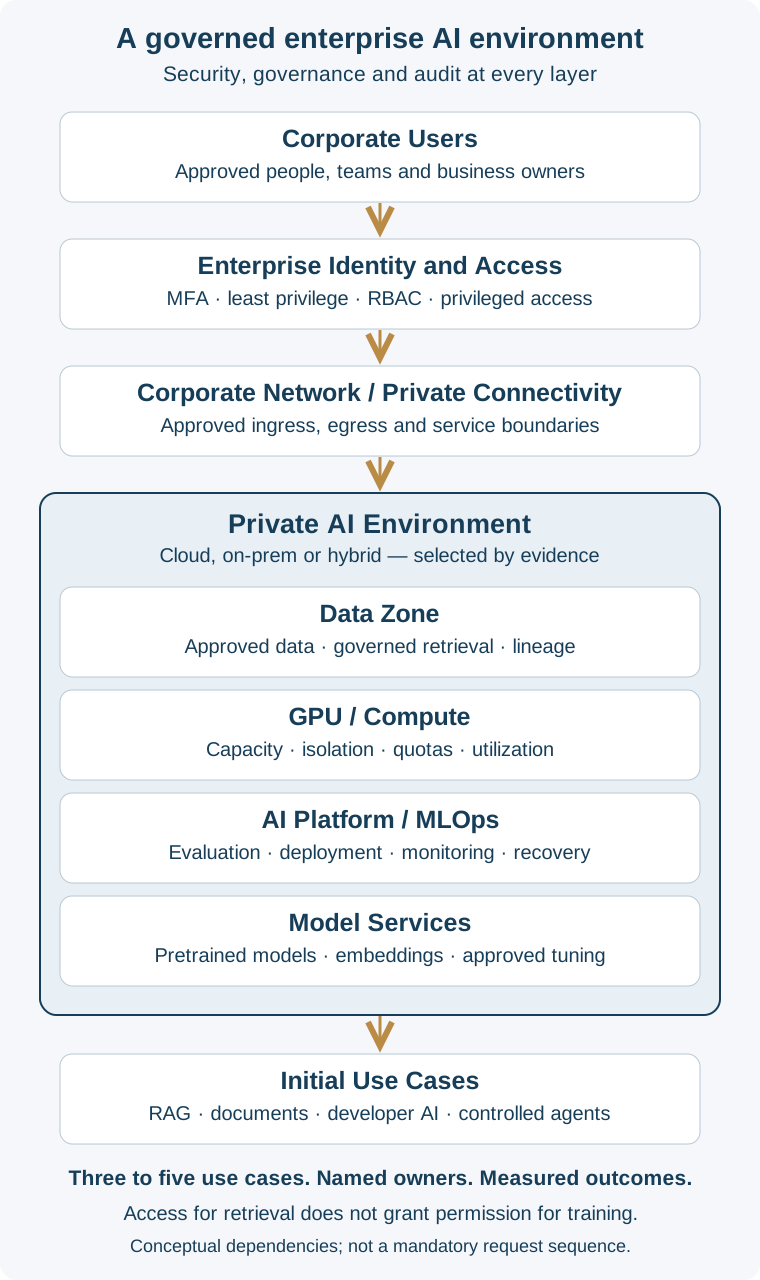
Users enter through enterprise identity and access. Corporate networking and private connectivity lead to the approved AI environment. Inside it, a governed data zone, GPU/compute capacity, the AI platform/MLOps layer, and model services support the initial use cases. The arrows show conceptual dependencies, not a rule that every request traverses every component in sequence.
Strong identity means MFA, least privilege, role-based access control (RBAC), and privileged identity management (PIM) or equivalent time-limited administration. Private networking, encryption in transit and at rest, and customer-controlled keys where justified complement those controls. Segment data domains and keep development, evaluation, and production permissions distinct.
Govern vector stores as data stores. Retrieval must enforce the user’s current authorization, including document-level permissions where required. Track data and model lineage, evaluate prompt injection and unsafe tool use, and keep sensitive information out of unnecessary telemetry. Human review remains essential for high-impact decisions.
Prompts, responses, embeddings, caches, vector databases, telemetry, and logs can all contain or reveal sensitive information. Give them explicit access and retention policies, deletion processes, and audit trails. Permission to retrieve data for RAG does not automatically confer permission to train or fine-tune a model on that data. Approved purposes and contractual rights must cover each use separately.
Compliance follows the data and the business process
The applicable obligations depend on the information, jurisdiction, organization, and use case. Examples include HIPAA/HITECH obligations for applicable healthcare information; PCI DSS for payment-card environments; consumer and state privacy laws for personal information; biometric privacy requirements where applicable; and financial-services regulatory expectations. Data residency and sovereignty, contractual confidentiality, trade secrets, and internal enterprise policies may impose additional constraints.
Two distinctions prevent confusion: PII is a data category, not a single regulation, and PCI DSS is an industry security standard, not a law. Neither label by itself establishes what a particular AI workflow may do. The PCI Security Standards Council’s overview defines the standard’s payment-data security purpose; the California Privacy Protection Agency illustrates that privacy rights and duties arise from specific legal frameworks. Applicable biometric rules, such as Illinois BIPA section 15, require their own assessment.
A cloud service’s certification, attestation, contractual commitment, or regulatory capability does not make the final enterprise AI solution compliant automatically. The organization remains responsible for its architecture, configuration, access, permitted use, monitoring, data handling, retention, and actual business process. HHS cloud guidance makes clear that using a cloud service for electronic protected health information still requires applicable agreements, risk analysis, and safeguards. Provider assurances are inputs to assurance, not its conclusion.
Use the NIST AI Risk Management Framework and its Generative AI Profile to organize AI risk work, and the NIST Cybersecurity Framework to connect it to enterprise cybersecurity governance. These are frameworks for managing risk, not certifications of legal compliance. Translate the relevant obligations into controls, owners, evidence, and review gates with the organization’s legal, privacy, security, and risk specialists.
Measure the workload before choosing the scale
Measure both technical demand and the complete human workflow. Useful evidence includes:
- Utilization and demand: GPU utilization where GPUs are operated, memory pressure, CPU demand, concurrency, queue depth, throughput, idle time, and the shape of peak demand. For managed APIs, track requests, tokens, throttling, latency, and spend instead of assuming visibility into provider GPUs.
- Quality and safety: task-specific accuracy, groundedness, retrieval coverage, permission correctness, failure modes, abstention, unsafe outputs, and the amount of human correction needed.
- Unit economics: cost per accepted task or successful outcome, including inference, retrieval, storage, transfer, support, evaluation, and human review. Cost per token is useful but incomplete.
- Adoption and value: repeat use by intended users, completion rates, cycle-time changes, avoided rework, service quality, and business benefit compared with the baseline.
- Operational readiness: availability, incident frequency, recovery performance, deployment repeatability, policy exceptions, and ownership of continuing support.
Set thresholds before the review. Do not let an aggregate average hide peak-hour saturation or a favorable model score hide expensive human correction. Compare alternatives using representative traces and realistic growth scenarios, then repeat the evaluation as models and usage change.
Around day 90, decide whether the evidence supports continued learning, a bounded expansion, redesign, or stopping. The 180-day horizon should not become an automatic authorization for a permanent platform.
Example: Azure Deployment Options and Costs
The provider-neutral framework becomes more concrete when applied to one cloud environment. The following two tables adapt the deployment comparison and cost model from the Azure Starter AI Lab reference. Azure is an illustrative implementation choice; the same questions apply to other clouds and to owned infrastructure.
Executive Options Comparison
Five deployment patterns differ in capability, economics, physical data custody, and operating complexity. A Starter Lab should generate the measurements needed to choose among them. No option is universally superior; the target architecture must follow the workload, data requirements, and sustained demand.
| Option | Best fit | Advantages | Tradeoffs / risks | Data & security posture |
|---|---|---|---|---|
| Azure Starter AI Lab | A 90–180 day controlled learning period; three to five use cases; tens to hundreds of initial users. | Fast launch, low initial capital, elastic GPU use, enterprise identity, private networking, and a platform for measurement. | Capacity and quota constraints, variable GPU cost, provider-hosted physical infrastructure, and a deliberately limited initial scope for sustained training. | Approved data first; private endpoints; Entra ID and role-based access; organization-controlled keys where appropriate; exclude unapproved public SaaS model services. |
| On-Prem Starter AI Lab | A 90–180 day learning period where physical data custody or existing datacenter capability is a priority. | Direct physical custody, predictable local access, no cloud GPU rental, a comparison baseline against cloud deployment, and reuse of existing infrastructure. | Higher initial capital, slower procurement and setup, limited burst elasticity, and responsibility for GPUs, power, cooling, and support; low demand can strand capacity. | Organization-operated network, identity, encryption, and access controls; physical custody does not replace software and data controls. |
| Azure Enterprise AI Lab | A shared enterprise platform serving multiple business domains, model families, and production services. | Elastic capacity, incremental expansion, managed MLOps options, large training bursts, and reduced need for datacenter build-out. | Potentially high recurring cost at sustained utilization; FinOps discipline, service dependency, and regional GPU availability matter. | Logical and cryptographic controls, private connectivity, explicit data classification, and workload zoning across approved boundaries. |
| Hybrid Enterprise AI Lab | Sensitive or sustained workloads run on-prem while Azure supplies approved burst capacity. | Workload-specific custody and elasticity; sensitive workloads can remain local while cloud capacity handles peaks. | Integration complexity, duplicated operating disciplines, cross-boundary data design, and additional observability and incident ownership. | Place workloads by data classification and permitted use; keep restricted data local where required and use cloud services only within approved boundaries. |
| On-Prem Enterprise AI Lab | A permanent enterprise AI/HPC capability with high, sustained utilization. | Direct physical custody, predictable installed capacity, potentially favorable economics at heavy utilization, and reduced cloud dependency. | High capital cost, long procurement cycles, hardware refresh, power, cooling, networking, and HPC operations; limited burst elasticity. | The organization operates the full hardware, software, key, network, security, and recovery control stack. |
The Azure Starter Lab is a learning vehicle. Its purpose is to create evidence for the enterprise architecture decision, not to predetermine it.
Illustrative Cost Model
These are the reference’s illustrative planning bands, not vendor quotes or an exact Azure bill. Actual cost depends on GPU generation and hours, model sizes, training frequency, discounts, staffing, data volume, support, regional capacity and pricing, and service mix. Amounts are in US dollars.
| Option | Platform / security | GPU compute | Data / network / facility | Engineering / operations | Indicative envelope | Cost behavior |
|---|---|---|---|---|---|---|
| Azure Starter AI Lab | $25K–$75K | $30K–$120K | $10K–$40K | $35K–$100K | $100K–$300K first year | Shut down idle GPU compute; retain a small persistent data and platform footprint. |
| On-Prem Starter AI Lab | $15K–$50K | $75K–$250K | $25K–$100K | $35K–$100K | $150K–$500K initial, plus roughly $30K–$120K/year operations | Higher initial commitment and predictable local capacity; sustained utilization improves economics, while idle GPUs can strand capital. |
| Azure Enterprise AI Lab | $250K–$1M | $1M–$10M+ | $250K–$1.5M | $1M–$4M | $2.5M–$16M+/year | Training bursts and inference concurrency make cost highly workload-dependent. |
| Hybrid Enterprise AI Lab | $7M–$35M+ on-prem build | $0.5M–$5M+/year Azure burst | $2M–$10M initial fabric / storage | $1M–$5M/year | $8M–$45M+ initial, plus $2M–$10M+/year | Owned baseline capacity plus cloud bursts; integration adds cost and operating complexity. |
| On-Prem Enterprise AI Lab | $5M–$30M GPU / HPC | $0 cloud GPU rental | $2M–$15M fabric / storage / facility | $1M–$5M integration; $1.5M–$8M/year operations | $8M–$50M+ initial, plus $1.5M–$8M/year | Heavy GPU utilization can improve economics; hardware refresh remains a material cost. |
Read each row as a scoped planning scenario, not as an additive price list. The reference mixes initial investment, recurring expenditure, and component ranges whose periods and boundaries need to be confirmed. The indicative envelope is not an additional charge, and annual operations already represented in that envelope must not be counted twice. The engineering bands do not establish a budget for five to ten newly funded full-time salaries; labor and support coverage need their own explicit business-case assumptions.
Uncertain or bursty demand can favor rented capacity when idle compute is released. Sustained utilization warrants a comparison with ownership. Hybrid design is justified when workload placement resolves a demonstrated custody or capacity constraint. Measure utilization, concurrency, token volumes, data growth, training frequency, latency, and cost per accepted business outcome before choosing among these models.
Example: What an Azure Starter AI Lab Should Measure
The framework applies equally to other cloud providers and to an on-prem environment. Azure is used here to make the discussion tangible: a controlled Starter AI Lab serving three to five approved use cases, with identified business owners, governed datasets, and bounded experimentation. The provider supplies implementation choices; leadership still owns the outcomes, controls, and investment decisions.
What the Starter AI Lab Must Measure
A Starter AI Lab should produce evidence, not merely demonstrations. Define a baseline, an accountable owner, an evaluation method, and a review threshold for each successful outcome. Record results by use case and data classification so that a useful average does not conceal an expensive workload or an unacceptable failure.
| Category | Representative measures | Leadership question |
|---|---|---|
| Business value | Cycle-time reduction, productivity improvement, avoided effort, adoption, and measurable business outcomes against the baseline. | Is the use case creating enough value to continue after human review and support are counted? |
| Model quality | Task accuracy, groundedness, hallucination rate, retrieval precision/recall, and evaluation results on representative tasks. | Does the capability meet its acceptance criteria, including permission checks and failure handling? |
| Platform performance | Latency, throughput, concurrency, availability, and reliability under normal and peak demand. | What service level and capacity does the real workflow need? |
| Economics | Cost per request, cost per active user, GPU utilization, idle capacity, and training-job cost. | Is demand sustained or bursty, and what does an accepted business outcome cost? |
| Governance | Approved data usage, policy compliance, audit coverage, security findings, and exceptions with named owners. | Can the organization operate this workload within its approved data and risk boundaries? |
These measurements are an engineering-leadership instrument. Weak adoption or uncertain quality can justify remaining at Starter scale. Variable demand may justify expanding cloud capacity. Sustained, heavily utilized compute can justify evaluating on-prem investment. A demonstrated need to separate workloads by data custody or capacity may justify hybrid architecture. None of those choices follows from a single utilization number; value, economics, service requirements, and security evidence must agree.
Measure GPU utilization only where the organization operates GPU capacity. With managed model APIs, record request and token volumes, throttling, latency, and spend; do not infer the provider’s hardware utilization. Retrieval precision/recall and hallucination rates also need defined test sets and scoring methods before they can support a decision.
Example: Where the Azure Starter AI Lab Budget Goes
The article’s illustrative $100K–$300K first-year Cloud Starter AI Lab range is a planning envelope for bounded platform setup and experimentation, not an Azure quote or an exact bill. The example assumes reuse of existing enterprise capabilities and shared contributors. Actual cost varies significantly with GPU class, GPU hours, model sizes, training frequency, data volume, networking, support, regional pricing, negotiated enterprise discounts, and staffing.
Cost Behavior and Control Mechanisms
| Category | Cost behavior | Main control mechanism |
|---|---|---|
| GPU compute | Often the most volatile infrastructure cost. Active experimentation, training, and inference drive demand; unused running capacity still incurs compute cost. | Set quotas, schedule workloads, shut down or scale down idle compute, monitor utilization, and assign an owner and spending limit to expensive jobs. |
| Storage/data | Usually persistent and more predictable than GPU usage. Curated data, model artifacts, checkpoints, and copies accumulate beyond individual experiments. | Use lifecycle policies, storage tiering, retention rules, curated datasets, and controls on duplication; account for retrieval and transaction costs when choosing tiers. |
| Networking | Private connectivity, inter-region movement, transfer, and egress patterns can create continuing costs and workload-dependent charges. | Make data movement visible, justify region boundaries and private connectivity, and avoid repeated transfers through deliberate architecture. |
| Platform / observability | Often a smaller persistent baseline for model lifecycle, telemetry, logging, secrets, identity integration, security monitoring, and shared tooling; telemetry volume can still grow. | Reuse approved platform capabilities, bound log volume and retention, allocate costs by use case, and review the services that remain active between experiments. |
| People | Multidisciplinary labor can exceed cloud infrastructure cost once architecture, platform, data, ML, security, compliance, product ownership, and operations are included. | Make participation and support coverage explicit, record effort by use case, and distinguish shared contributors from newly funded full-time roles. |
Possible implementation choices include Azure GPU VMs or Azure Machine Learning compute for operated workloads, Azure Data Lake Storage for governed data, and VNets/Private Link for approved connectivity. Entra ID and Key Vault can support identity and secrets, while Azure Monitor, Log Analytics, and Cost Management can support operational and spending visibility. These are examples of capabilities, not a required product stack.
Compute controls must follow the actual resource lifecycle. Microsoft’s Azure Machine Learning cost guidance describes quotas, workload-based scaling, and scheduled compute controls. Its VM billing guidance distinguishes stopping from deallocation; persistent disks and other resources can continue to incur charges. Storage lifecycle policies provide a separate way to manage retained data and storage tiers.
Do not force the complete labor and operating model into the infrastructure envelope. A fully loaded business case must show internal labor, incremental hiring or contracting, support, and opportunity cost explicitly. Five to ten contributors do not imply that five to ten new full-time salaries fit inside $100K–$300K. Track both the cloud bill and the total cost of producing an accepted outcome.
The 90-Day Decision Gate
After roughly 90 days of controlled operation, leadership should be able to answer the following questions with evidence. The review date is a decision point, not permission to scale automatically.
- Are the selected AI use cases producing measurable business value against their baselines?
- What does a real AI workload actually cost, including human review, support, and continuing operations?
- How much GPU capacity is genuinely being utilized where GPUs are operated, and how much is idle?
- Is compute demand sustained or bursty, including its peak duration and frequency?
- Which data classifications are actually required by the successful use cases?
- What production concurrency, latency, availability, and reliability are needed?
- What security, compliance, governance, and operational controls proved necessary?
- What architecture is justified by the evidence: remain at Starter scale, Cloud Enterprise, On-Prem Enterprise, or Hybrid Enterprise?
The progression is deliberate: start with a Starter AI Lab, measure actual use and cost, establish the real data-security and compliance requirements, distinguish sustained demand from bursts, and then choose the next architecture. Remaining small, redesigning a use case, or stopping it can be a sound outcome. Scale is a decision the evidence must earn.
Enterprise scale is an operating model
A successful Starter Lab does not become an enterprise platform simply by adding GPUs. A shared service needs accountable platform engineering, MLOps, SRE, data engineering, AI security, model risk and governance, networking, storage, FinOps, research where justified, and domain teams. The organization must decide who owns reliability, model changes, data access, cost allocation, incidents, and retirement.
Some responsibilities can use existing capabilities or managed services; others need dedicated capacity. Budget for the actual coverage model, including support outside ordinary hours where required. Define service objectives, promotion criteria, model and data change controls, evaluation gates, rollback, disaster recovery, and a process for retiring capabilities that no longer create value.
Reusable foundations should reduce the cost of the next approved use case. If every team creates its own identities, vector stores, model gateways, monitoring, and policy exceptions, growth is multiplying operational debt. Standardize the boundaries and repeatable controls while preserving room for justified experimentation.
Three decisions the evidence should support
First, is the use case worth continuing? If adoption is weak, quality is inadequate, or the fully measured benefit is small, stop or redesign it. More infrastructure will not repair an unconvincing value proposition.
Second, where should the workload run? Variable or uncertain demand may favor cloud elasticity. Sustained, heavily utilized capacity warrants a serious comparison with ownership. Data custody, residency, or contractual restrictions can constrain either choice. Hybrid placement is appropriate when its additional complexity resolves a measured need.
Third, what capability should be funded next? Approve a defined capacity increment, control improvement, or operational capability against a named workload and business owner. Record the assumptions, expected benefit, budget ceiling, review date, and exit conditions. A move to enterprise scale should pass business-value, technical-capacity, economic, security, and operational gates together.
The Starter Lab is not a miniature version of the eventual enterprise platform. It is not a commitment to a particular cloud, hardware vendor, or final deployment model. Its purpose is to create measurable evidence about the organization’s actual AI workload.
An enterprise should earn the right to spend millions by first learning what it needs to run, what it can safely use, what people adopt, and what produces lasting value.
Start small enough to learn.
Govern well enough to trust.
Measure carefully enough to know when to scale.

About the author
Vasili Katsoulis
Vasili Katsoulis believes the future belongs to engineering leaders who understand both timeless software engineering principles and modern AI. His work explores how technical depth, architectural thinking, and engineering judgment enable organizations to build better software in the age of AI.